

Sarhad Dairy
Amul Pattern
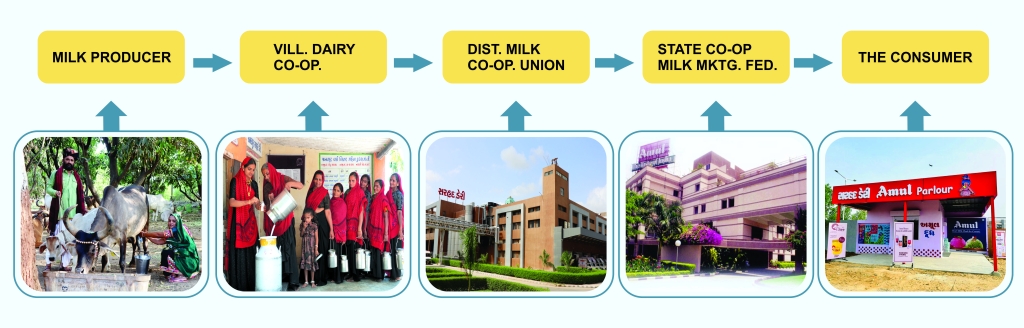
- The Kaira District Co-operative Milk Producers’ Union (Amul) is headquartered at Anand. Planners, economists, administrators, dairymen, journalists have been visiting Anand to study the ingredients of its success.
- The Anand Pattern is essentially an economic organizational pattern to benefit small producers who join hands forming an integrated approach in order to the economy of large scale business. The whole operation is professionally managed so that the individual producers have the freedom to decide their own policies. The adoption of modern production and marketing techniques helps in providing those services that small producers individually can neither afford nor manage.
- It has succeeded largely because Anand Model involves people in their own development and because their interests are safe in their own hands. Under Operation Flood the entire institutional infrastructure set up at the village level, the district level and the state level is owned and operated by the farmers themselves. The Anand Model co-operatives have progressively eliminated middlemen, bringing the producers in direct contact with consumers.
- The Anand Pattern succeeded because it gave a fair price to the farmer and high – quality milk and milk products to the consumer. What would have been middlemen’s profits in the earlier system got absorbed into development projects for primary producers or lower cost for the consumer? In short, the Anand Pattern meant the utilization of resources in the most profitable manner at the grass-root level.
The Three Tier Structure
The First-Tier – Primary village Co-operative Society
- An Anand Pattern village dairy cooperative society (DCS) is formed by milk producers. Any producer can become a DCS member by buying a share and committing to sell milk only to society. Each DCS has a milk collection center where members take milk every day. Each member’s milk is tested for quality with payments based on the percentage of fat and SNF. At the end of each year, a portion of the DCS profits is used to pay each member a patronage bonus based on the quantity of milk poured. This also acts as a vital link for various productivity enhancement and development programs of farmers programs.
District Union The 2nd Tier – District Union: District Union
- A District Cooperative Milk Producers’ Union is owned by dairy cooperative societies. It is a Union of primary village co-operative societies within a district. The Union buys all the societies’ milk, then processes and markets fluid milk and products. Union also provides a range of inputs and services to village co-operative societies and their members: feed, veterinary care, artificial insemination to sustain the growth of milk production and the cooperatives’ business. Union staff train and provide consulting services to support village co-operative society leaders and staff.
The State Federation – 3rd Tier The State Federation
- The cooperative milk producers’ unions in a state form a State Federation which is an apex marketing body responsible for the marketing of milk and milk products of member unions. The Federation also plays a role in the overall development of the district unions federated to it. Maximizing farmer profit and productivity through cooperative effort is the hallmark of the Anand Pattern.
Social impact The spread of the co-operative movement in the villages is contributing to social changes. Some of the changes are:
- The democratic process – election of the village society’s office-bearers – is breaking down social and economic divisions. The society is being perceived as a means of livelihood – unlike, say, a panchayat. The feeling, therefore, is that it ought to be managed by those who are likely to run it most efficiently – not necessarily by the entrenched elite.